What to see inside Holyrood Palace, room by room
The forecourt and the Great Stair
You start in the forecourt by the fountain, with Arthur’s Seat rising directly behind the palace and the Scottish Parliament facing it across the road. Most of what you then walk through is the baroque quadrangle rebuilt in 1671–78 for Charles II to Sir William Bruce’s design, and the Great Stair is where that rebuilding first shows off.
The state apartments
The Royal Dining Room comes first, and it is the one visitors talk about afterwards. The table settings for grand dinners are the draw — Justina, an American reviewer, wrote “Wow for the dining room that seats 400 guests”, and I have watched plenty of people stand there doing the arithmetic. Then the Throne Room and the drawing rooms, still used for royal engagements — this is a working palace, and the King stays here every summer — before the King’s Bedchamber, the grandest room of the 1670s sequence.
The Great Gallery
The largest room in the palace, about 44 metres end to end, hung with Jacob de Wet II’s portrait series of Scottish monarchs real and legendary, painted 1684–86 — nearly a hundred portraits in all. Bonnie Prince Charlie held court in this palace in 1745; the gallery is where you feel that history most directly.
Mary, Queen of Scots’ chambers
The route then steps out of the baroque palace into the older north-west tower, where Mary lived from 1561 to 1567. Her supper room is where David Rizzio was seized in 1566, and the outer chamber floor carries the spot said to be his blood stain. I go through the murder, and the honest answer on the stain, on the Mary, Queen of Scots page.
The abbey ruins and the gardens
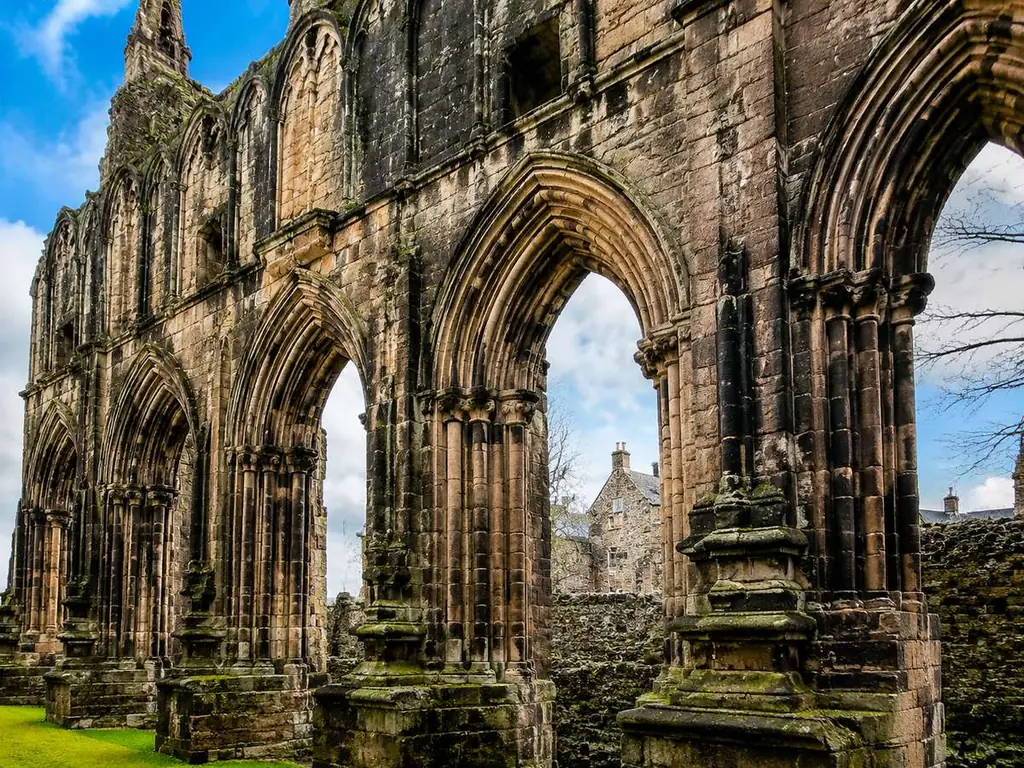
You leave through Holyrood Abbey — the 1128 Augustinian foundation the whole site grew from, now a roofless nave that is the most photogenic thing here — and then the gardens, still used for royal engagements including the summer Garden Party. Both are covered by the standard ticket; details of what entry costs are on the prices page. Occasional event closures affect the gardens, so a check of the opening dates before you travel is worth thirty seconds.
Phones off and no photography inside the palace — the stewards do enforce it. The abbey ruins are where the camera earns its place, so keep some patience for the end of the route.
See it with the multimedia guide
The standard entry ticket includes the multimedia guide in nine languages, and the whole circuit takes about ninety minutes.
Frequently asked questions
Can you take photos inside Holyrood Palace?
No — the Royal Collection Trust does not permit interior photography, and phones go off at the security check. Outside is a different matter: the abbey ruins and gardens at the end of the route are the shots worth waiting for. The full visit runs about ninety minutes.
Is Holyrood Abbey included in the palace ticket?
Yes. The ruined abbey and the gardens are part of the standard visitor route, not paid extras — every 2026 price is on the cost page.
Are Mary, Queen of Scots’ rooms open to visitors?
Yes, her chambers in the north-west tower — including the supper room tied to the Rizzio murder — are on the standard route. I cover them properly on the Mary, Queen of Scots page.
Is there a guide, or do you walk round alone?
Entry includes a multimedia guide in nine languages, with a British Sign Language version available, and you set your own pace along the one-way route. Reviewers rate it well — Valentina from Spain called it very well explained, and Szostak from France praised the French version.